When you are looking to buy your first piece of chainmail armor—whether it is a full hauberk, a coif, or a simple shirt—you will instantly run into two terms that dominate the market: Riveted and Butted. If you are new to the world of medieval armor, these technical terms can feel a bit overwhelming. Does it really matter how the rings are closed? Is one genuinely better than the other, or is it just marketing hype?
The short answer is yes, it matters immensely. Choosing the wrong type of chainmail can mean the difference between a durable investment that lasts a lifetime and a piece of gear that falls apart after your first event. Let’s break down the real, practical differences between riveted and butted chainmail so you can spend your hard-earned money on the perfect kit for your needs.
Ready to Upgrade Your Medieval Kit? Don’t settle for flimsy replicas that lose rings every time you move. Our handcrafted, battle-ready chainmail collections are designed for an authentic look, historical weight, and unmatched field durability. 👉 [Browse Our Full Chainmail Armor Collection Now]
Understanding Butted Chainmail: The Budget-Friendly Option
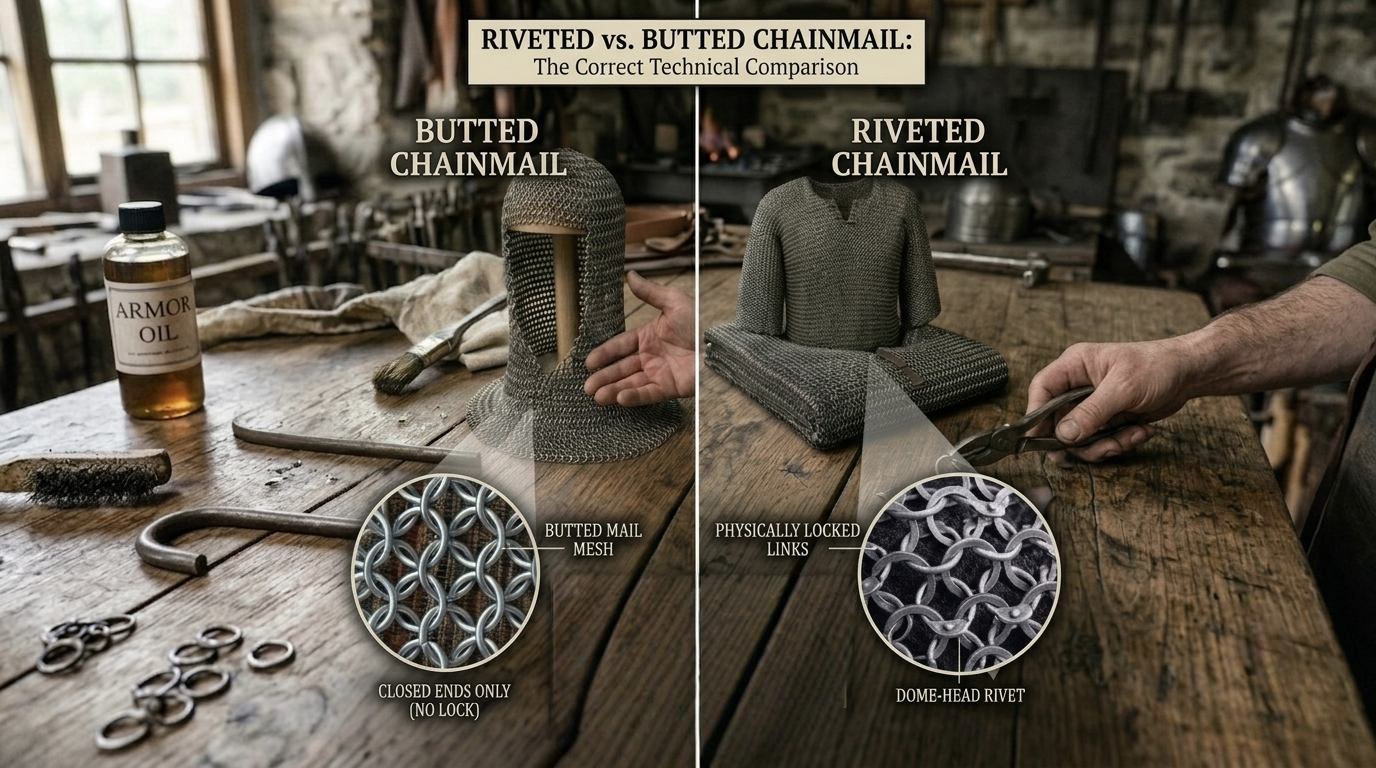
Let’s start with butted chainmail. The concept here is very simple. To make butted mail, an armorer takes a piece of wire, cuts it into a ring, bends it closed until the two open ends are touching (or “butting” against each other), and weaves it into the pattern. That’s it—there is nothing physically locking the ring closed except the natural tension of the metal itself.
The Pros of Butted Mail:
-
Highly Affordable: Because it requires significantly less time and labor to assemble, butted mail is much easier on your wallet.
-
Great for Display & Lightweight Cosplay: If you just want a stunning piece to hang on your wall, wear to a local renaissance faire, or use for theater and lightweight costumes, butted mail looks fantastic and gets the job done.
The Cons of Butted Mail:
-
Zero Structural Strength: Since the rings are not locked, they can easily pull open under stress. If you sit down too fast, lean heavily, or catch the armor on something, rings will inevitably stretch out and fall off.
-
Absolutely Not Battle-Ready: If you plan to participate in any full-contact combat or heavy reenactment, butted mail will fail instantly under a weapon strike.
Understanding Riveted Chainmail: The Authentic Warrior Standard
Now, let’s look at the historical standard. Riveted chainmail is how real medieval blacksmiths actually made armor to save lives on the battlefield. To create a riveted ring, the two ends of the wire are overlapped, flattened, a tiny hole is punched through them, and a metal rivet is inserted and smashed shut using specialized pliers. Each individual ring is physically locked forever.
The Pros of Riveted Mail:
-
Maximum Durability: You can jump, run, engage in full-contact combat, and take heavy blows without worrying about your armor coming apart. The links simply cannot pull open.
-
Historically Accurate: If you take pride in the authenticity of your kit, riveted mail gives you the exact weight, feel, and craftsmanship relied upon by historical knights.
-
Lifetime Investment: A well-maintained riveted hauberk can easily be passed down to the next generation without losing its structural integrity.
The Cons of Riveted Mail:
-
Higher Initial Cost: Punching a tiny rivet into tens of thousands of individual rings takes incredible craftsmanship and weeks of intense hand labor, making it more expensive upfront.
Pro-Tip For True Reenactors: If you are planning to step into the shield wall or take part in any live-action combat, don’t waste your time with gear that will break on day one. Invest in armor that commands respect. Check out our heavy-duty, hand-crafted Riveted Mild Steel Hauberks. 🛒 [Get Your Battle-Ready Riveted Hauberk Today – Free Shipping]
Which One Should You Choose?
To make your decision incredibly simple, just ask yourself one basic question: What am I going to use this armor for?
-
Choose Butted Chainmail if: You are on a strict budget, your primary goal is costume/cosplay visual impact, you are using it for a theater production, or it is going to stay on a static display mannequin in your office.
-
Choose Riveted Chainmail if: You practice HEMA, SCA, or any full-contact medieval reenactment, you want a piece of gear that feels entirely authentic, or you simply want to buy a durable product once and never have to worry about replacing missing rings again.
Conclusion: Invest in Craftsmanship
At the end of the day, your armor tells a story about your passion for history. While butted mail has its place for casual costuming, nothing compares to the weight, structural security, and historic pride of owning a real, hand-riveted chainmail garment. It is an investment in authenticity that you will appreciate every single time you gear up.
Experience True Historical Quality Don’t let cheap replicas ruin your historical experience. Whether you need a full hauberk, a coif, or an authentic mail shirt, Armor Medieval delivers the premium craftsmanship you deserve. 🚀 [Shop Armor Medieval Today & Claim Your Battle Gear]